

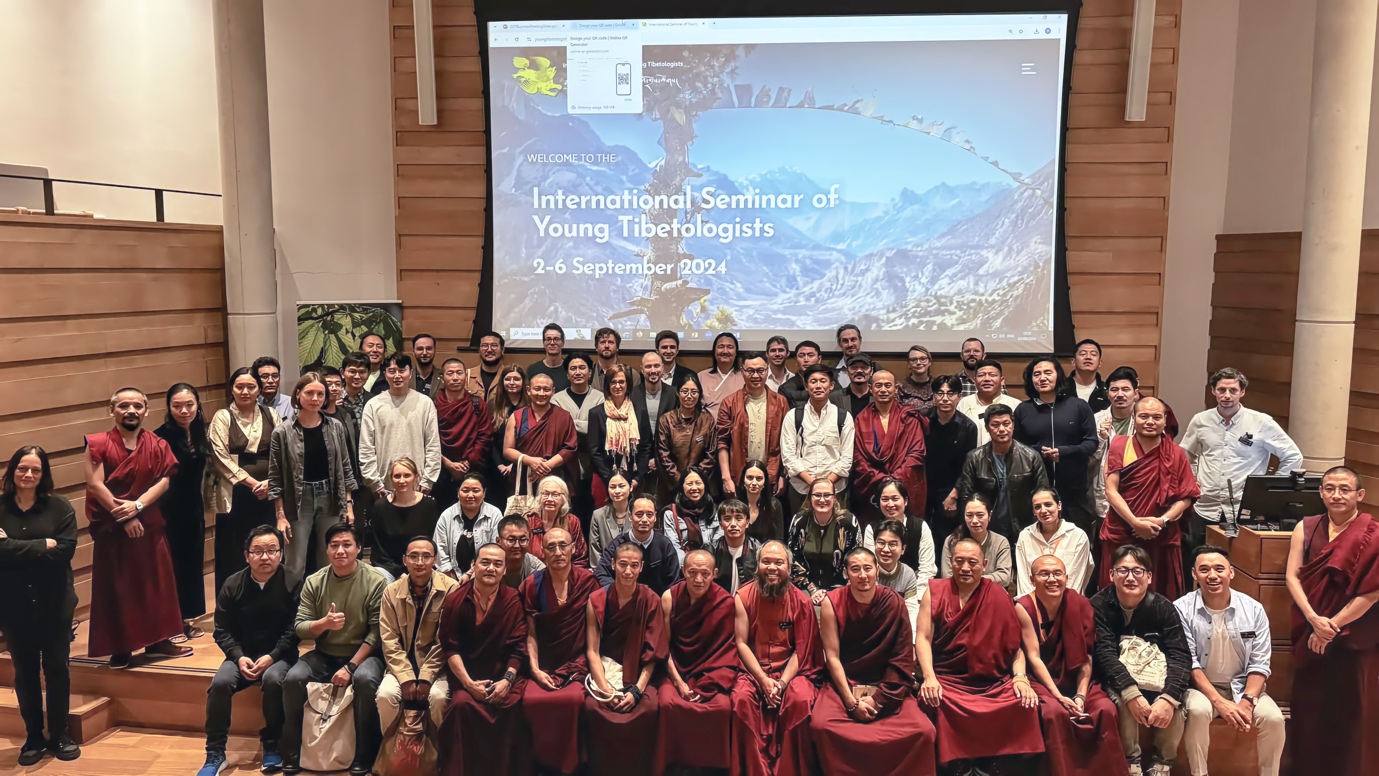





The Seventh International Seminar of Young Tibetologists (ISYT) was hosted by the Tibetan & Himalayan Studies Centre at Wolfson College, University of Oxford, from September 2–6, 2024. With 358 applications yielding 85 paper presenters, 4 poster presenters, and 102 delegates from nearly 30 countries, it was one of the largest ISYT to date. Following the opening address by the three conveners Daniel Wojahn, Jacob Fisher, and Darig Thokmay, Professor Ulrike Roesler welcomed delegates with a historical perspective on Oxford and Tibetan Studies, and Dr Lama Jabb offered a poetic reflection on Tibet's past and present through song and creative writing.
The conference featured 30 thematic sessions showcasing the breadth of contemporary Tibetan Studies, from the integration of Digital Humanities approaches such as AI translation and digital archives, to research on traditional almanacs and their relevance to understanding climate change. Sessions on contemporary Tibet addressed cyber statecraft, cultural preservation, and identity formation in exile communities, while Women's Studies panels brought fresh perspectives on gender in Tibetan society. These newer directions were complemented by strong representation in manuscript studies, Buddhist philosophy, art history, and ritual studies.
The conference benefited greatly from the participation of 16 monastic scholars representing institutions including Menri Monastery, Kirti Monastery, Dzongsar Institute, and Gyuto Monastery, several of whom presented manuscripts and historical documents never before studied in an academic context. This participation was made possible by the generous support of the Spalding Trust, whose funding was instrumental in enabling monastic scholars from across the Tibetan cultural region to attend, directly furthering one of the conference's core aims of fostering dialogue between traditional and contemporary scholarship.
Cultural events ran throughout the week: a screening of the documentary Geshe Wangyal: With Blessing of the Three Jewels with a Q&A session with director Ella Manzheeva; guided visits to the Tibetan special collections at Oxford's Weston Library; a screening from the “Animated History of Tibet” project with creator Alex Smith; a Khaita dance performance followed by a Tibetan-style picnic on the Harbour Lawn of Wolfson College; and the Shangshung UK Institute's Bardo Series exhibition at the Oxford Friends Meeting House, showcasing the artwork of Drugu Choegyal Rinpoche.
The “Tibetan Digital Library” project, an initiative of the Department of Religion and Culture of the Central Tibetan Administration, maintained an information hub throughout the conference. Scheduled for launch in 2025, the project integrates AI technologies including optical character recognition and text-to-speech, developed with the Buddhist Digital Resource Center, the Wadhwani Institute for Artificial Intelligence, and Monlam AI. A Tibetan-language workshop on research methodology, attracting 38 participants, provided a further bridge between traditional scholarship and contemporary academic practice.
The Business Meeting on Thursday produced several significant developments for ISYT's future. South Korea was selected as the host for the 8th ISYT, marking the conference's second venture into East Asia. Two of the convenors, Daniel Wojahn and Darig Thokmay, were elected Secretary-General and President respectively, along with five new board members, and participants voted to require bilingual presentation materials (Tibetan-English) at future seminars to enhance accessibility and scholarly exchange.
The 7th ISYT revealed the expanding horizons of Tibetan and Himalayan Studies, where traditional textual scholarship now converges with media studies, digital innovation, and evolving cultural identities. The selection of South Korea as the next venue, the developing “Tibetan Digital Library” project, and the conference proceedings scheduled for publication in late 2025 all suggest that the energy and scholarly collaboration witnessed at Oxford will continue to shape the field in the years to come.
We have also been featured in a recent interview with Voice of America Tibetan.